
The Initial Success and Subsequent Plateau
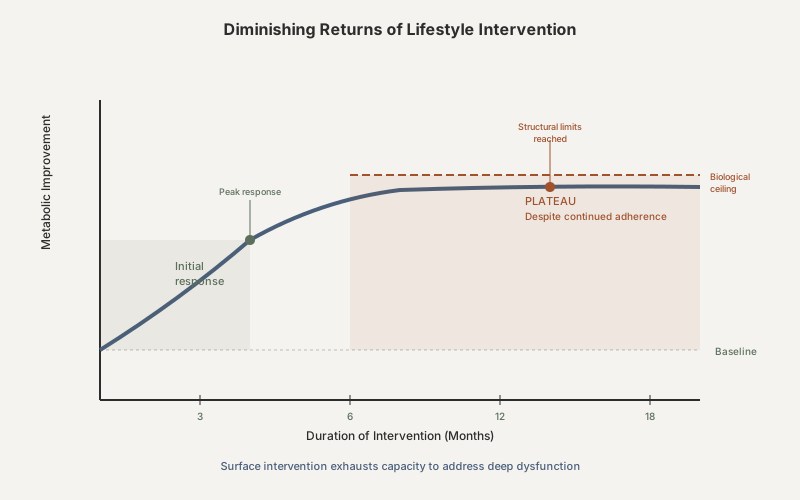
For many newly diagnosed diabetics, lifestyle modification produces remarkable initial results. Dietary changes reduce glucose spikes. Weight loss improves insulin sensitivity. Regular physical activity enhances cellular glucose uptake. Within weeks or months, glucose readings improve substantially. HbA1c drops. Medication requirements decrease or disappear entirely. The intervention appears to have worked.
This early success creates understandable optimism. If dietary adjustment and exercise produced such dramatic improvement, surely continued adherence will maintain or further enhance results. Patients commit to their new routines. They follow nutritional guidelines carefully. They maintain regular physical activity. They do everything recommended by physicians and diabetes educators.
Yet for many—particularly those with longer disease duration before intervention—improvement eventually stalls. Glucose levels that initially dropped to near-normal begin creeping upward despite unchanged behavior. Weight loss plateaus or reverses despite continued dietary adherence. HbA1c stabilizes at levels higher than target despite sustained lifestyle modification. Medication that was reduced must be restarted. The intervention that once worked powerfully now maintains marginal effects at best.
This plateau phenomenon frustrates patients and puzzles physicians. The same interventions that produced dramatic early improvement now fail to generate further progress. Patients often face implicit or explicit accusations of non-adherence. If lifestyle changes worked initially, the reasoning goes, then maintained changes should maintain improvement. Plateau must reflect hidden dietary lapses or exercise avoidance.
But for many patients, adherence is not the issue. They maintain their dietary patterns. They continue their exercise routines. They follow all recommendations. The plateau occurs not from behavioral failure but from biological limits—points where lifestyle intervention alone cannot address the depth of metabolic dysfunction present.
"Ayurveda identifies this plateau as the transition from Sama Ama to Sthira Ama — from active, mobile metabolic residue that responds to dietary intervention, to deeply embedded residue that requires targeted internal purification to move."
Ayurvedic Clinical Lens · Diabetes Reversal Clinic
When Adaptation Becomes Structural
Early in diabetes progression, metabolic dysfunction remains primarily functional rather than structural. Insulin resistance exists but cellular machinery remains intact. The pancreas produces adequate insulin but works harder than normal. Hepatic glucose regulation is impaired but the liver retains capacity. At this stage, lifestyle intervention can shift metabolic balance enough to substantially improve function because the underlying systems still possess reversibility.
But as disease duration extends—particularly beyond five to ten years—dysfunction crosses from functional to structural. Cellular adaptations become permanent. Insulin receptors do not just function poorly; they are physically degraded and reduced in number. Mitochondria are not just inefficient; they are damaged and depleted. Gene expression is not just temporarily altered; it is epigenetically reprogrammed.
These structural changes create biological limits to what lifestyle modification can achieve. Dietary improvement reduces glucose load, but damaged cells cannot properly process even moderate glucose. Exercise enhances insulin signaling, but when signaling pathways are structurally degraded, enhancement reaches a ceiling. Weight loss improves metabolic parameters, but when organs have undergone years of adaptive remodeling, weight reduction alone cannot restore their function.
The plateau occurs where lifestyle intervention exhausts its capacity to compensate for structural pathology. Further dietary restriction, more exercise, additional weight loss—these may produce minimal additional benefit because the underlying dysfunction now requires repair at cellular and molecular levels that surface interventions cannot access.
The Limits of Caloric and Macronutrient Management
Dietary intervention for diabetes typically focuses on carbohydrate reduction, caloric restriction, and macronutrient optimization. These approaches succeed when metabolic dysfunction is mild because they reduce glucose load and insulin demand on systems that retain basic functional capacity. The pancreas can handle reduced secretory requirements. The liver responds appropriately to decreased glucose input. Muscle tissue processes available glucose with improved efficiency.
In advanced diabetes, these same dietary modifications encounter biological resistance. The pancreas has lost substantial beta-cell mass—reducing carbohydrate intake decreases demand, but cannot restore secretory capacity that no longer exists. The liver has developed profound insulin resistance—eating less does not repair hepatic insulin signaling pathways that have been structurally degraded. Muscle tissue has depleted mitochondrial density—dietary changes cannot regenerate energy-producing organelles that have been lost.
Further dietary restriction often becomes counterproductive. Severe carbohydrate limitation can trigger increased hepatic gluconeogenesis—the liver producing more glucose internally to compensate for reduced external intake. Aggressive caloric restriction slows metabolic rate and reduces lean muscle mass, worsening insulin resistance. Patients find themselves eating progressively less while glucose control deteriorates—evidence that the problem lies not in dietary excess but in cellular inability to properly process any amount of nutrients.
Exercise Limitations in Advanced Metabolic Dysfunction
Physical activity improves diabetes through multiple mechanisms: enhanced insulin sensitivity, increased muscle glucose uptake, improved mitochondrial function, reduced inflammation. In early disease, these benefits accumulate substantially. Regular exercise can dramatically improve glycemic control and reduce medication requirements.
But exercise benefits depend on intact metabolic machinery to respond to training stimulus. Muscle adaptation to exercise requires functional mitochondria to increase in number and efficiency. Improved insulin sensitivity requires intact insulin signaling pathways to become more responsive. Enhanced glucose uptake requires adequate glucose transporter expression and function.
When these systems have undergone years of degradation, exercise response becomes blunted. Muscles with depleted mitochondrial content cannot substantially increase oxidative capacity. Cells with structurally impaired insulin signaling cannot dramatically improve sensitivity. The training stimulus that should trigger adaptation encounters biological systems that have lost adaptive capacity.
Moreover, exercise in the context of severe metabolic dysfunction can generate additional oxidative stress that damaged cells struggle to handle. The acute glucose-lowering effects of activity persist, but the long-term adaptive benefits that should accumulate over time fail to materialize because cellular repair systems cannot execute the necessary remodeling.
The Multi-System Coordination Problem
Lifestyle interventions primarily target individual components of metabolism—reducing glucose input, increasing glucose disposal, improving insulin sensitivity. But advanced diabetes increasingly involves failure of coordination between systems. The liver, pancreas, muscle, fat tissue, and brain lose their ability to communicate and synchronize metabolic responses.
When coordination fails, improving individual components produces limited overall benefit. Dietary changes might improve hepatic glucose output, but if the pancreas cannot appropriately adjust insulin secretion in response, net glycemic control barely improves. Exercise might enhance muscle glucose uptake, but if fat tissue continues releasing excess fatty acids that worsen hepatic insulin resistance, the exercise benefit is negated.
Surface interventions cannot restore this lost coordination because coordination depends on intact hormonal signaling, appropriate autonomic nervous system function, and cellular responsiveness across multiple organ systems. Lifestyle changes affect some components of this network but cannot rebuild the network itself when it has degraded over years of disease progression.
Why Intensifying Surface Interventions Fails
When lifestyle modification plateaus, the typical response involves intensification: stricter dietary restriction, more exercise, more aggressive weight loss targets. The logic assumes that if moderate intervention produces moderate results, more intensive intervention will produce better results.
But this logic fails when the plateau reflects structural biological limits rather than insufficient intervention intensity. Forcing more aggressive surface changes when cellular dysfunction is the primary problem generates minimal additional benefit while imposing substantial burden.
Patients adopt increasingly restrictive eating patterns that compromise quality of life and nutritional adequacy. They push exercise to levels difficult to maintain long-term or that risk injury. They achieve additional weight loss that reduces lean muscle mass and slows metabolism. These sacrifices produce minimal glucose improvement because they do not address the cellular, mitochondrial, inflammatory, and hormonal dysfunction driving the disease at deeper levels.
The intensification approach also creates psychological damage. Patients blame themselves for insufficient willpower or commitment when their heroic efforts produce disappointing results. They cycle through increasingly extreme interventions, each promising breakthrough but each eventually plateauing. The repeated failure erodes confidence and motivation, making sustained healthy behavior progressively more difficult.
Recognizing When Deeper Intervention Becomes Necessary
Reversal resistance—the point where lifestyle modification stops producing improvement despite continued adherence—signals that current intervention depth does not match disease complexity. Surface changes remain necessary and beneficial, but they have reached the limit of what they can accomplish alone. Further progress requires addressing dysfunction at cellular, organ, and systems levels.
Several patterns suggest reversal resistance has occurred: glucose levels that initially improved but then stabilized above target despite unchanged lifestyle; medication requirements that decreased initially but then stabilized or increased despite continued healthy behavior; progressive complications despite good lifestyle adherence and reasonable HbA1c; persistent symptoms like fatigue and cognitive difficulty despite controlled glucose readings.
Recognition of reversal resistance should not lead to abandoning lifestyle modification—diet and exercise remain foundational. But it should prompt investigation into what drives the resistance: extent of cellular dysfunction, degree of organ damage, inflammatory burden, hormonal dysregulation, genetic factors affecting metabolic repair capacity. Understanding the specific biological barriers allows targeted intervention beyond surface lifestyle changes.
What Lies Beyond Lifestyle Plateau
Moving past lifestyle plateau requires intervention capable of addressing structural metabolic dysfunction: reducing cellular inflammatory load, supporting mitochondrial regeneration, restoring insulin signaling pathway function, rebuilding pancreatic reserve capacity, reestablishing organ-system coordination. This work operates at depths that diet and exercise alone cannot reach.
Such intervention may involve targeted metabolic support, specific anti-inflammatory approaches, mitochondrial enhancement strategies, or systematic correction sequences that address dysfunction in appropriate order. The goal shifts from managing glucose through behavioral modification to progressively restoring metabolic function through cellular and organ-level repair.
Lifestyle modification remains essential within this framework—it provides the foundation on which deeper correction builds. But recognizing its limits in advanced disease allows appropriate escalation to intervention sophistication that matches disease complexity. The plateau is not failure. It is biological feedback indicating that the work must now proceed at levels beyond what surface changes can access. Ayurvedic perspective: When lifestyle changes stop producing results, Ayurvedic logic suggests the pathology has moved beyond the reach of surface interventions — and that the next stage of correction must work at the tissue level, not the dietary one.